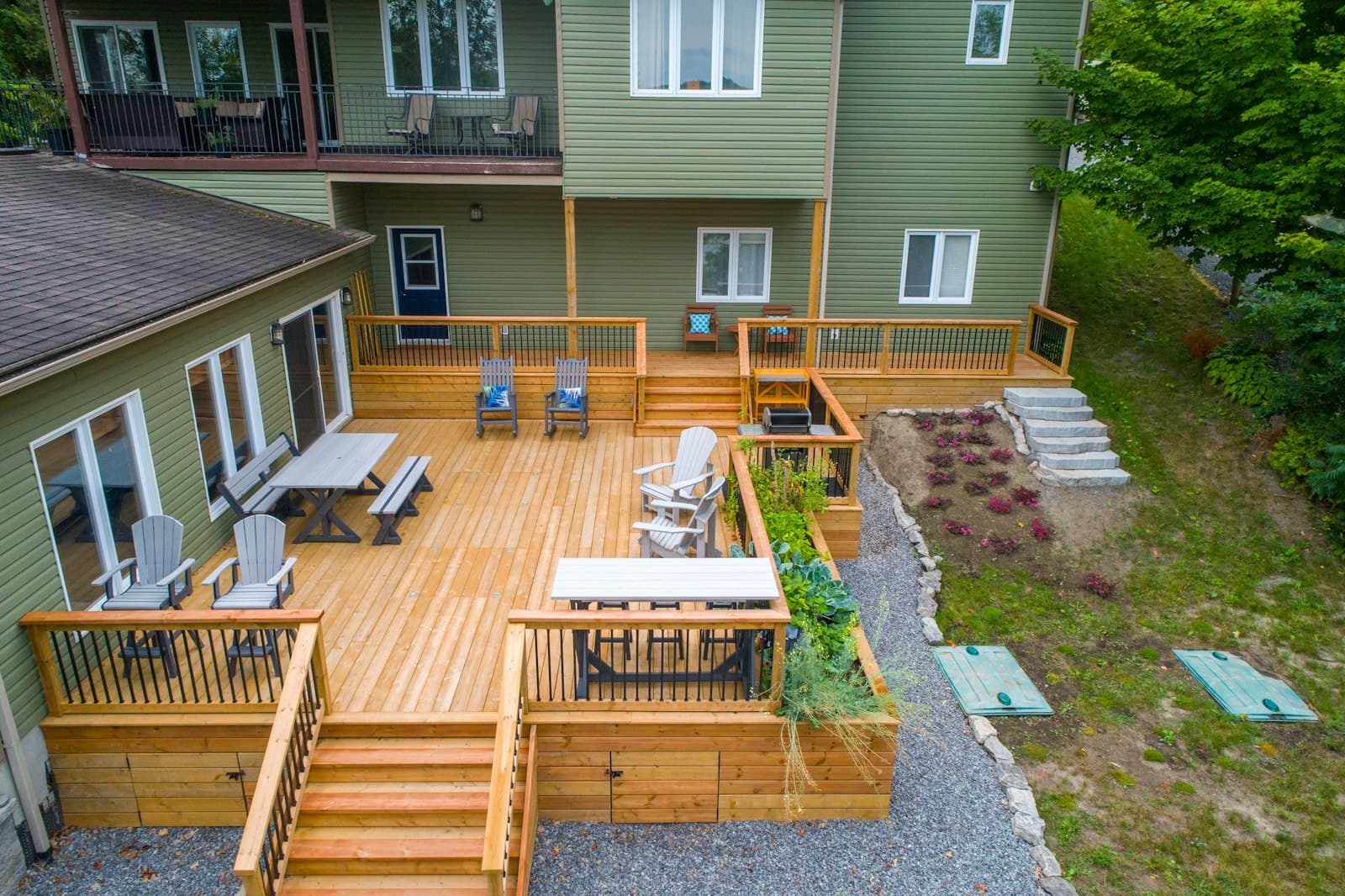
Capped composite has been the GTA’s default deck upgrade since roughly 2020, and the share of new residential decks built in composite has been climbing every year since. The pitch is simple: you pay more at install in exchange for a deck that essentially looks after itself for 25 years. The math holds up — but only if you know what you’re actually paying for, and where Ontario builders quietly mark up.
Below is what a composite deck costs installed across southern Ontario in 2026, in CAD before HST, broken down by board tier, deck size, and the line items that move the spread.
The 2026 baseline number
For a mid-tier capped composite deck on a level lot in the GTA in 2026, expect installed pricing of $55–$85 per square foot. That’s the all-in rate the calculatoruses, and it tracks what you’ll see in real quotes from GTA contractors this year. Premium PVC-capped composite (Trex Transcend, TimberTech Legacy) runs roughly 25–40% higher than mid-tier.
Put another way, for the four canonical sizes a GTA homeowner actually builds:
- 10 × 10 (100 sq ft): $9,500–$13,500 installed (mid-tier composite, 2–4′ off grade, aluminum railing, 3 steps to grade, permit included). Per-square-foot rate looks high here because fixed costs dominate a deck this small.
- 12 × 12 (144 sq ft): $11,500–$16,500 installed. The most common “starter” composite size in the GTA.
- 12 × 16 (192 sq ft): $14,500–$20,500 installed. The sweet spot for most Toronto and Mississauga backyards — big enough for a six-seat table, small enough to clear coverage bylaws without variance.
- 16 × 20 (320 sq ft): $22,500–$32,000 installed. Suburban lots in Vaughan, Markham, Oakville, and Burlington often get here when the homeowner wants a clear dining-plus-lounging split.
Every one of those numbers comes out of the same calculator the city pages use. The per-city tables on each citypage show how the figures shift when the local default material isn’t composite (the four Durham + Brampton + Hamilton pages default to pressure-treated because that’s what dominates new builds there in 2026).
What you’re actually paying for
Composite decking material itself accounts for roughly 30–40% of the installed line on a typical GTA quote. The rest is labour, framing lumber, fasteners, railings, stairs, and the contractor’s margin. The three biggest movers within that:
- Board tier.A 16 × 12 deck in Trex Enhance (entry capped composite) versus Trex Transcend (premium PVC-capped) differs by roughly $3,000–$4,500 installed in 2026 GTA pricing. The board itself costs more and the labour to finish the edges typically runs slightly higher because premium boards usually come with hidden-fastener systems.
- Hidden vs face fastening.Hidden fasteners (clips that hide screw heads) add roughly $2–$4 per square foot in labour. On a 200 sq ft deck that’s $400–$800. Most premium composite installs include them — some mid-tier installs upcharge for them as an option line.
- Picture framing and inlays.A picture frame (perimeter board running perpendicular to the field boards) costs ~$300–$700 in labour and material on a typical residential deck. Two-tone inlays double the count of mitre cuts and add $600–$1,500. These are easy to skip if budget is tight, but they’re the visual difference between a builder deck and a custom one.
Where the spread comes from
The $55–$85 per-sq-ft range above is honest but wide. Three things move you across that range, in order of importance:
1. The contractor’s book of business
A GTA composite specialist with a 3-month waitlist will quote in the upper half of the range. A generalist contractor adding decks as a shoulder-season trade will quote in the lower half — not because they’re worse, but because composite labour has a learning curve (the boards expand and contract differently from wood, fastening details matter) and the specialist’s rate prices that experience in. Both rates are legitimate.Just know which one you’re paying for.
2. Height off grade
Composite material itself is height-agnostic; the framing under it is not. A ground-level 12 × 16 composite deck and a 6-ft-elevated 12 × 16 composite deck use the same surface boards, but the elevated version needs heavier posts, deeper footings, longer guards, and stair structure to grade. Expect 15–30% more in installed cost for elevated work, plus the permit’s almost always required.
3. Demolition of an existing deck
Most GTA composite deck builds replace an old pressure-treated deck rather than start from grass. Demolition and disposal of the old deck runs $4–$8 per sq ft, plus disposal fees. On a 200 sq ft replacement that’s $800–$1,600 added to the quote — usually itemized separately so you can see it.
The brand question, briefly
Three brands dominate Ontario composite decking in 2026: Trex, TimberTech, and Fiberon. Each has a mid-tier line and a premium line. For the cost question specifically:
- Trex Enhance / TimberTech Edge / Fiberon Sanctuary (mid-tier capped composite):$7–$10 per linear ft retail at GTA lumberyards, installed at the lower half of the $55–$85/sq ft range.
- Trex Transcend / TimberTech Legacy / Fiberon Concordia (premium):$11–$16 per linear ft retail, installed at the upper half of the range or higher.
The brand difference within a tier is much smaller than the tier difference. We have a full brand comparison in the Trex vs TimberTech vs Fiberon article that goes deeper on warranty terms, fade resistance, and what each brand looks like at year 10.
Where in southern Ontario composite is most worth it
Composite’s install premium versus pressure-treated is roughly 70–100% on a like-for-like build. That premium pays back fastest in:
- Lakefront and waterfront communities— Burlington, Oakville lakeshore, Pickering, Whitby, Ajax. Salt spray and constant moisture accelerate PT degradation; composite shrugs it off.
- Homes with mature trees— central Toronto, older Mississauga and Etobicoke. Falling debris and sap on PT requires aggressive cleaning to prevent staining; composite cleans up with a hose.
- Family homes with young kids— no splinter risk, no annual stripping/sealing cycle taking the deck out of commission for three days every spring.
Composite is least worth it on small low-use decks where the install premium is a meaningful percentage of household budget and the maintenance burden of PT was never going to be high in the first place. A 10 × 10 PT deck off a basement walkout that gets used twice a year doesn’t need composite’s warranty.
What to ask for in a composite quote
When you’re comparing quotes across two or three GTA contractors, ask each one to itemize:
- Board brand, line name, and colour (not just “composite”)
- Fastener system: hidden, face-screwed, or hybrid
- Whether picture framing is included or optional
- Joist spacing (16″ centres is the composite default; some premium boards allow 24″ with engineering)
- Warranty registration responsibility (the builder usually files; confirm it)
Quotes that omit those items aren’t necessarily wrong — but the ones that volunteer them up front are usually the contractors you want to be working with.
The bottom line
Composite decking in Ontario in 2026 installs at $55–$85 per sq ft for mid-tier capped boards, $75–$120 per sq ft for premium PVC-capped. The price difference between a competent generalist and a composite specialist is real and usually worth paying. The price difference between mid-tier and premium board lines is also real and depends on whether you’re building a deck you’ll keep for 10 years or for 25.
Plug your exact dimensions into the calculator, toggle between PT, cedar, composite, and PVC, and you’ll see the per-line breakdown for your specific build. The per-city pages have the same calculator with the locally-typical defaults pre-loaded — useful if you want to see what the median build in your municipality actually prices to.