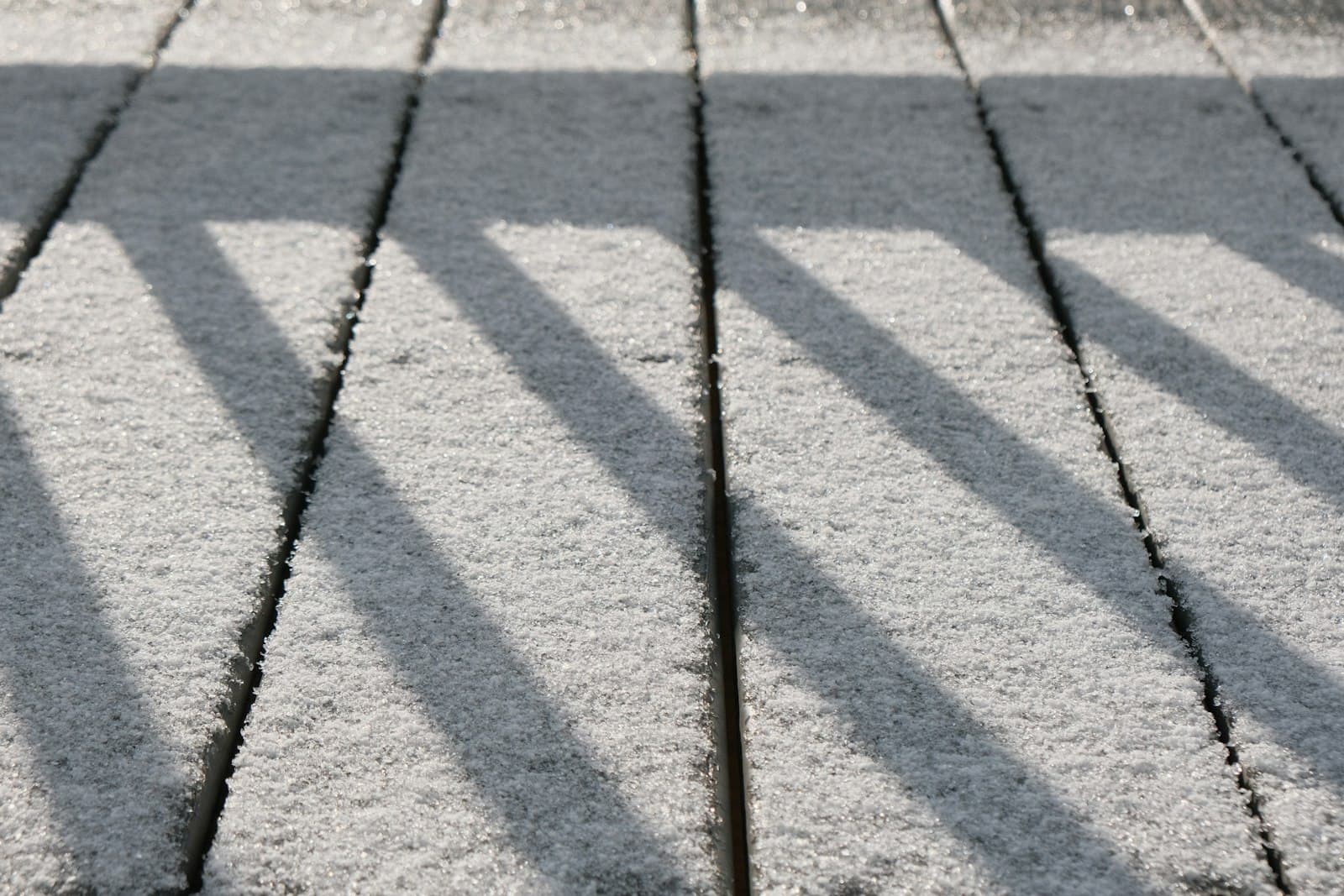
Walk down any Toronto residential street in late March, before the gardeners arrive, and you can identify a five-year-old pressure-treated deck from the sidewalk. The boards have started to cup — the long edges have lifted and the centre has sunk. The screws are sticking up a millimetre or two above the surface. The deck reads tired, even though it was perfectly flat four years ago.
Homeowners blame the lumber. The lumber yard blames the installer. The installer blames the weather. All three are sort of right and sort of wrong. The actual cause is freeze-thaw chemistry, and once you understand it, the repair options become obvious.
What’s actually happening
Pressure-treated lumber is wood that’s been forced to absorb a chromated copper preservative (the modern formula is alkaline copper quaternary, or ACQ) under pressure. The preservative makes the wood resistant to fungal rot and insects. It does not make the wood waterproof. Pressure-treated boards still swell when wet and shrink when dry — just like any wood — and the treatment chemistry actually makes the wood slightly more hygroscopic than untreated lumber.
Toronto’s winters do two specific things that compound this:
- Freeze-thaw cycling, 60–80 times per winter. Most southern Ontario winters bring the deck through the 0°C boundary roughly every 36–48 hours from late November through early April. Each cycle, any water absorbed into the board freezes (expanding 9%), then thaws and migrates. Over 80 cycles, the cellular structure of the wood is mechanically fatigued. The board can no longer hold its original shape.
- Asymmetric moisture loading.The top of the board dries out faster than the bottom because air and sun reach it; the bottom stays wet against the joist and the cold ground air below. The top shrinks while the bottom expands. The board cups upward at the edges — the classic Ontario pattern.
This is why the cupping always points up, never down. It’s why it appears on the third or fourth winter, not the first — the first two winters the board still has enough internal moisture equilibrium to resist. By winter four, the cumulative damage shows.
Why the screws lift
Once the board cups, the long edges rise relative to the centre. The screws are anchored in the joist below; the board edge is physically moving up around the screw. The screw appears to be lifting, but it’s actually the board moving. This is the most commonly misdiagnosed symptom — homeowners drive the screws deeper, the screw head countersinks below the deck surface, and the cupping continues because the underlying cause hasn’t been addressed.
Driving screws deeper is the wrong intervention. It accelerates end-of-life because it splits the board around the screw, introducing new water entry points.
The four interventions that work
In order of cost and effectiveness:
1. Annual sealing (preventive)
The single most effective thing you can do is seal the deck once a year, every year, with a penetrating oil-based water repellent. Penetrating means it soaks into the cellular structure of the wood; film-forming finishes (polyurethanes, deck paints) sit on top and peel off within two winters in Toronto’s freeze-thaw cycle.
Brands that work in southern Ontario: Cabot Australian Timber Oil, Sansin SDF, TWP 100 Series. Apply in late May or early September on a dry deck, two coats, with 4–8 hours between coats. Plan for about $100–$160 in product and a half day of labour for a 200 sq ft deck.
This single annual ritual is the difference between a 15-year pressure-treated deck and a 25-year one. It will not reverse existing cupping, but it stops the progression.
2. Selective board replacement (early-stage)
If a handful of boards have started to cup but the rest are flat, replace only the affected boards. Pressure-treated boards from the same lumber yard, dried in the same conditions, will dimension-match the rest of the deck within 1–2 mm. Use stainless or ceramic-coated deck screws (galvanized fasteners react with the ACQ treatment and corrode within five years).
Cost: $8–$15 per linear foot of board replaced, including labour, in 2026 GTA pricing. A typical bad-board run on a five-year-old deck is 6–12 board-feet, so $200–$500 of repair work. Cheap insurance.
3. Sand and re-seal (mid-stage)
If the cupping is widespread but the boards are structurally intact, the deck can be belt-sanded flat and resealed. This is labour-intensive (an experienced finisher takes 8–14 hours for a typical Toronto backyard deck), removes 1–2 mm of board thickness per pass, and only buys you 4–6 years before the cupping recurs — because the underlying moisture asymmetry problem isn’t fixed.
Cost: $4–$8 per sq ft in the GTA, so $800–$1,600 for a 200 sq ft deck. Only makes sense if the board structure is sound and you’re willing to commit to the annual seal afterward.
4. Flip the boards (the trick the professionals use)
Every pressure-treated deck board has a relatively flat side and a relatively curved side. They’re installed flat-side-up at install time. When the deck is 6–10 years old and the boards have started to cup but the structure is sound, you can carefully unscrew each board, flip it, and reinstall it. The previously-bottom side is now exposed to drying conditions; the previously-top side is now under the slow-drying conditions. Within one full freeze-thaw cycle, the cupping reverses.
This is what professional deck-restoration crews actually do on older pressure-treated decks in Toronto and Hamilton. It’s roughly half the cost of full board replacement and gets the deck another 6–10 years of useful life. The catch: the bottom face of the board has visible joist marks and old fastener holes, so the finished appearance is rougher than new lumber.
Cost: $3–$6 per sq ft labour in the GTA, plus new fasteners. A 200 sq ft deck runs $700–$1,400 for a flip-and-reseal job. Most homeowners don’t know this option exists, which is why most premature deck replacements are unnecessary.
When the deck is past saving
The signals that a pressure-treated deck has reached real end-of-life:
- Joists are spongy.Push a screwdriver into the joist edge. If it sinks more than 3–4 mm with light pressure, the joist is rotting and any board work on top is cosmetic.
- Multiple boards have cracked end-to-end. Splitting along the grain is structural, not cosmetic. Boards with longitudinal cracks are not safe to flip.
- The deck moves under your weight. Bounce on it. If you feel ledger or joist deflection, the framing is the problem.
At end-of-life, the math on rebuilding versus reframing-and-replacing usually favours a full rebuild. Reframing alone is $40–$60 per sq ft installed in 2026 GTA pricing — close enough to a new pressure-treated deck (the full cost article runs the numbers) that most contractors will quote a full rebuild anyway.
The honest version
Pressure-treated is still the most affordable way to put a deck in a Toronto backyard. It is also the most maintenance-dependent material sold in Ontario. Skip the annual seal and the deck reads old at year five. Stay current with the seal and the deck looks right at year fifteen.
The cupping you see on tired-looking decks across the GTA every spring isn’t lumber failure. It’s the deck telling you it hasn’t been sealed in three years. The fix is cheap if you catch it at year five. It’s expensive if you wait until year ten.
Run the numbers on a replacement at the calculator— pressure-treated is still the cheapest material, but the maintenance economics over a 15-year hold are where the trade-off actually lives. The cedar-vs-composite winter comparison runs the same analysis for the upgrade tiers.