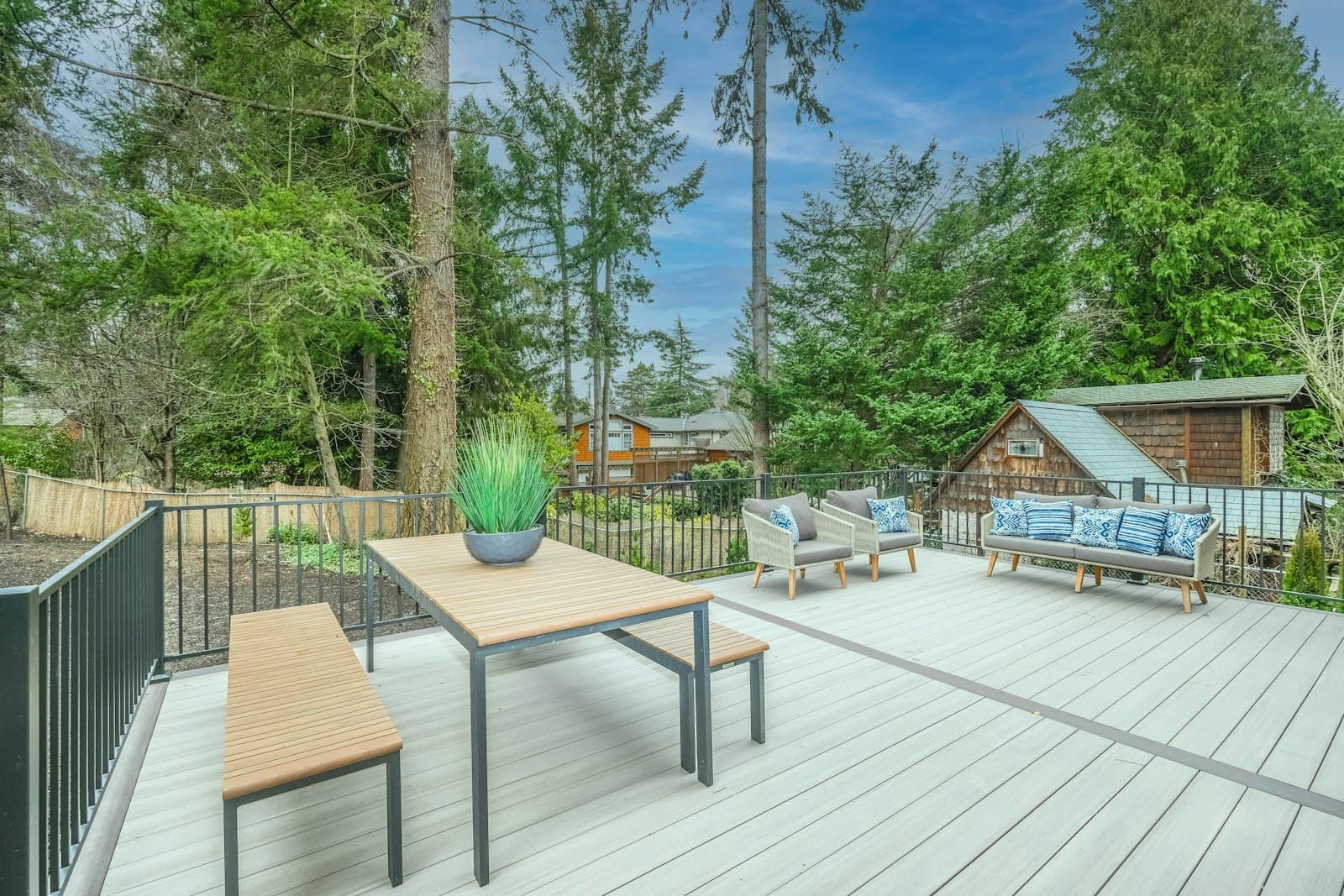
Toronto’s housing stock is unfair to composite. A 1928 Edwardian semi in Leslieville, a 1912 Victorian in Cabbagetown, a 1930s detached in Forest Hill — none of them look right with a grey composite deck attached to the back. The boards are dimensionally too thin, the colour is too uniform, the aluminum railing is too contemporary. The house wants cedar.
A traditional cedar deck, detailed properly, ages with a pre-war house in a way no other material can. It also has real cost implications, real maintenance load, and a set of design choices that need to be right or the whole thing reads as wood-decking Home Depot wrote a spec sheet for. Here’s the traditional Toronto cedar deck, what it costs, and the detailing that separates a real one from a copy.
The traditional cedar deck’s defining details
1. Board width: 6″ nominal, not 5/4″
Modern composite is universally a 5/4″ (one-and-a-quarter inch nominal) board, roughly 5.5″ wide. Traditional cedar decking is 2×6 (one-and-a-half inch nominal, 5.5″ wide), or in older builds, 1×6 (three-quarter inch nominal). The proportion difference reads immediately at the corner of the deck: a thicker board profile presents a more substantial elevation, which is what reads as traditional.
2×6 cedar from a Toronto lumberyard runs roughly $5–$9 per linear foot in 2026, depending on grade (clear-grade is roughly double the cost of knotty). On a 12 × 16 deck that’s about 200 linear feet of board — $1,000–$1,800 in material, before fasteners and labour.
2. Square-edged boards, not grooved
Modern composite boards are grooved on the sides to accept hidden clips. Cedar should be square-edged. The boards sit shoulder-to-shoulder with a 1/8″ to 3/16″ gap for drainage, fastened with visible deck screws.
Hidden fasteners on cedar are a category error. The visible screw pattern is part of the visual language of a traditional deck; concealing it produces a deck that doesn’t commit to either aesthetic.
3. Stainless or bronze fasteners, never galvanized
Cedar contains natural tannins that react aggressively with galvanized steel. A galvanized screw in a cedar board will produce a black bleed mark around the screw head within a single summer, and will corrode through within five to seven years — faster if the deck gets sealed (the seal traps moisture against the fastener).
Stainless steel (#316 marine-grade is excessive; #305 deck-grade is correct) costs roughly twice what galvanized does — about $40–$60 in fasteners for a 12 × 16 deck versus $20–$30 for galvanized. The right call every time. Silicon-bronze is the premium alternative; reads even more traditional but costs roughly 3× stainless.
4. Wood railing, properly proportioned
The defining vertical element of a traditional Toronto cedar deck is wood railing. The proportions matter:
- Top rail:2×6 cedar, sanded to a chamfered profile.
- Balusters:2×2 cedar at 4″ spacing (the Ontario code requirement). Square balusters read more traditional than the round/spindle profile, which tends to read as Victorian-revival rather than properly traditional.
- Bottom rail:2×4 cedar with a drip-relief on the underside.
- Posts:4×4 cedar at 5′–6′ intervals, with a 4×4 post cap detailed as either a flat cap or a pyramidal cap depending on house era.
Wood railing costs $35–$60 per linear foot installed in cedar — the cheapest railing option in the calculator defaults. For a 12 × 16 deck with railing on three sides and a 4′ stair opening, that’s roughly 36 linear feet, or $1,300–$2,200 installed.
5. Detailing on the elevations
A traditional deck doesn’t hide its substructure under composite skirting. The framing is exposed and detailed. The defining elements:
- Cedar fascia.A 2×10 cedar board runs along the exposed face of the rim joist, painted or stained to match the deck. Conceals the construction lumber underneath while staying in the cedar visual language.
- Cedar lattice on the perimeter. Below the deck surface and above grade, traditional pre-war Toronto decks enclose the underdeck space with a wood lattice (square or diagonal pattern). This both conceals the underdeck and matches the elevation language of period houses.
- Visible step nosing.Treads are 2×8 or 2×10 cedar with a 1.25″ nose overhang. The nose casts a shadow line that reads as a proper architectural step.
Cedar fascia + lattice skirting on a 12 × 16 deck adds roughly $1,000–$1,800 of materials and labour to the base deck cost. Often skipped on budget builds, which is why most budget cedar decks read as compromise rather than tradition.
What it costs all-in
A properly-detailed traditional cedar deck at the 12 × 16 reference size, in 2026 GTA prices:
- Base cedar deck (knotty grade): $11,500–$16,500 installed at the calculator’s cedar rate for the same reference build.
- Clear-grade upgrade:+$2,800–$4,200 (clear cedar is roughly double the per-board cost of knotty; the clear-vs-knotty article runs the math).
- Wood railing (already in calculator pricing): no upgrade required.
- Stainless fasteners:+$50–$80 over galvanized.
- Cedar fascia + lattice skirting: +$1,000–$1,800.
- Detailed step nosing:+$200–$400 in additional cedar over standard steps.
All-in: roughly $13,000–$19,000for the 12 × 16 reference build in knotty cedar with full detailing, or $16,000–$23,000 if clear-grade cedar is used throughout. The full breakdown in the cedar cost article runs the per-size pricing for both grades.
The maintenance reality you’re committing to
A cedar deck demands a specific yearly rhythm in Toronto:
- Annual cleaning, early May. Soft brush, mild deck cleaner, garden hose rinse. Removes the winter biological load.
- Penetrating oil re-application every 18–24 months.Cabot, Sansin SDF, or TWP 100-series. $200–$400 in product and a half-day of work.
- Spot splinter repair annually. The full repair guide covers the order of operations.
- Replace 2–4 boards every 5–7 years as the worst-positioned ones (heaviest UV or weather exposure) deteriorate.
Total maintenance cost over a 20-year hold: roughly $5,000–$8,000 in DIY labour and materials, or $10,000–$15,000 if you contract it out.
When traditional cedar makes sense, and when it doesn’t
Cedar is the right material for:
- Pre-war Toronto detached, semi-detached, and rowhouses (1900–1945). The proportions and visual language match.
- 1950s and 1960s ranch houses where the architecture itself is warm and wood-forward.
- Homes where the back garden is mature and forested, and the deck reads as an outdoor room rather than a contemporary element.
- Owners who genuinely enjoy the annual maintenance ritual. Some people do; for them the smell of cedar oil being applied on a Sunday in May is part of the appeal.
Cedar is the wrong material for:
- Post-1990 builds in Mississauga, Brampton, Vaughan. The architecture wants composite.
- Owners who travel half the year and won’t commit to the maintenance load.
- South-facing decks with no tree cover. The UV degradation rate is fast enough that a south-exposed cedar deck looks 8 years old at year 5, which defeats the point.
- Rental properties. Tenants will not do the maintenance, full stop.
What to ask a contractor
Cedar contractors are a smaller pool than composite contractors in the GTA. The diagnostic questions:
- How are you sourcing the cedar — specifically, which mill? A contractor who knows their cedar supplier will name a specific BC Coastal mill. One who buys from Home Depot will not.
- Show me a clear-grade vs knotty-grade sample board. A real cedar builder will have both on the truck. The visible difference is enormous and worth seeing before you commit to a grade.
- What fasteners do you use? The correct answer is stainless or bronze. Galvanized is a disqualifying answer.
- How do you handle the cedar/galvanized framing interface?The substructure (joists, beam) is pressure-treated; the deck above is cedar. The contact between cedar and galvanized framing hardware needs to be isolated — either with a rubber barrier (TruJoist Z-Max or equivalent) or by specifying stainless framing connectors. A contractor who has never thought about this will give a worrying answer.
The honest conclusion
Traditional cedar is a smaller share of the GTA deck market every year, but on the right house it’s the only material that reads correctly. Detail it properly — thicker boards, stainless fasteners, wood railing in the right proportion, visible substructure done well — and the deck is the most beautiful object in the backyard. Detail it casually and you have a budget cedar deck that looks worse than a budget composite one.
Run the numbers for your specific build at the calculator; the per-city pages show whether cedar is locally common or unusual for your municipality. For the modern composite counterpart, see the modern composite design article; for the cost framework underneath, the cedar cost article covers clear-vs-knotty grade economics.