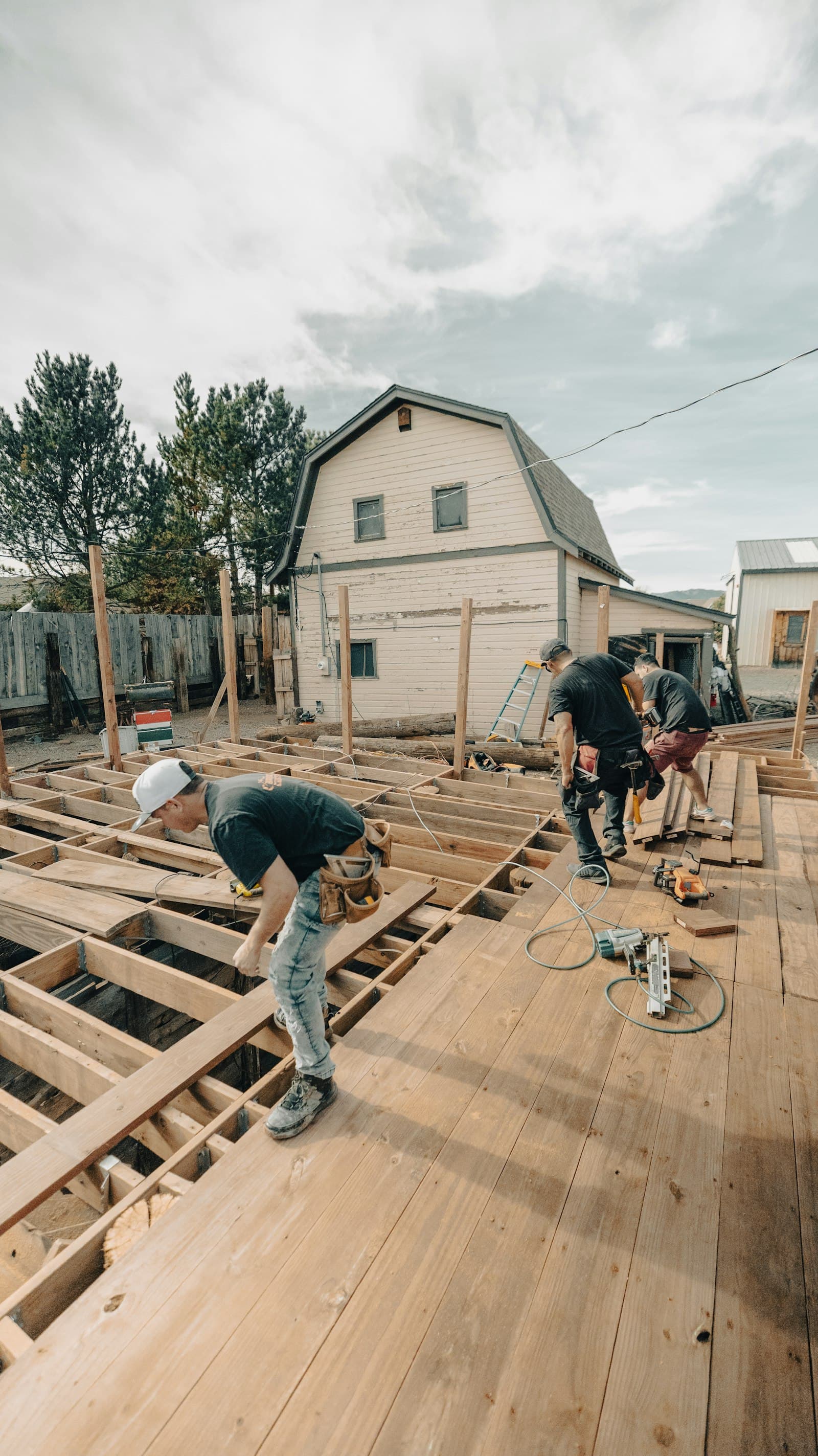
Most of the deck-permit anxiety I hear from homeowners is rooted in secondhand horror stories: a friend who waited eight months, a neighbour who got a stop-work notice, a contractor who insisted the permit “wasn’t worth it.” The reality of a residential deck permit in Toronto in 2026 is closer to administrative chore than ordeal — provided you know what Toronto Building actually wants in the application.
This is the walkthrough I wish I’d had the first time I helped a friend pull one. It covers what triggers a permit, what to submit, what it costs, and what to expect on timelines. I’ll flag what’s Toronto-specific so it’s clear which parts also apply across the rest of the GTA.
Does your deck need a permit?
In Toronto, you need a building permit for a deck if any of these are true:
- The deck is attached to the house.
- The deck surface is more than 24″ (60 cm) above adjacent grade.
- The deck is part of a means-of-egress (e.g. a required exit stairway).
- The deck has a roof, pergola, or any structural overhang that needs its own permit anyway.
The narrow exception is a free-standing deck no more than 24″ above grade and no larger than 10 m² (about 108 sq ft). Anything that fails one of those tests needs a permit. In practice this means most attached decks in Toronto need one, because even a single step up from a finished-grade walkout is usually over the 24″ threshold once you account for the joist depth.
What Toronto Building wants in the application
Toronto’s residential deck permit application is filed through the city’s online Toronto Building Application Submission system. For a typical attached deck under 600 sq ft, the package is:
- A site plan.A bird’s-eye drawing of the lot showing where the deck sits relative to the house, the lot lines, and any easements. Setback distances from each property line have to be dimensioned. This is where homeowners get tripped up most often — eyeball setbacks are not acceptable.
- Deck plans. Plan view (looking down) plus an elevation view (looking from the side). Both at a recognized scale like 1:50. Dimensions on every framing member, joist spacing called out, deck height from grade to finished surface clearly labelled.
- A framing plan.Beam size and span, joist size and on-centre spacing, post and footing size and locations, ledger connection details. The Ontario Building Code (OBC) and Toronto’s Residential Deck Guide both publish span tables you can reference directly — you don’t need a stamped engineering drawing for a typical deck under 6′ high with no roof.
- A guard and stair detail.If your deck is over 24″ high, you need a guard. Toronto wants the guard height (36″ minimum, 42″ if the deck is over 5′11″), baluster spacing (under 4″ sphere), and any stair geometry spelled out.
- An application form and the permit fee.Filed online. Fees are calculated based on the deck’s area.
What it costs
Toronto’s 2026 residential deck permit fees, before HST on the admin charge:
- Permit fee:approximately $245–$420 for most backyard decks. The base fee plus a per-square-metre charge.
- Zoning review:typically rolled into the building permit fee for residential decks, occasionally surfaces as a separate $150–$250 line if your lot triggers a setback variance.
- If your design needs a Committee of Adjustment minor variance:$1,500–$3,500 and adds 8–14 weeks to the timeline. This is the only realistic horror-story scenario for a backyard deck, and it’s avoidable by designing within your lot’s setbacks.
Across the rest of the GTA — Mississauga, Brampton, Vaughan, Markham, Oakville, Burlington — the per-deck permit fee runs roughly $250–$750. The structure of the application is almost identical; municipalities differ mostly in the online portal you file through and the exact zoning bylaw setback numbers.
Timelines: what to expect
For a straightforward deck permit with a complete application in Toronto:
- Initial review:10–15 business days from submission, often faster in off-season.
- Revisions, if requested:usually one round of minor clarifications (setback dimensions, framing notes). Add another 5–10 business days from re-submission.
- Total elapsed time:3–5 weeks from filing to approval is typical for a deck that fits the standard form.
The slowdowns aren’t in the review itself. They’re almost always at one of three points: (1) the homeowner submitted without a framing plan, (2) the site plan is missing setback dimensions, or (3) the deck design encroaches on a setback and needs a variance the homeowner didn’t realize was triggered. All three are pre-application problems.
Inspection points
Toronto inspects deck builds at two points:
- Footing inspectionafter the sonotubes are dug and before concrete is poured. The inspector wants to confirm depth (below the 1.2 m frost line in the GTA) and footing diameter. Schedule this one carefully — same-day or next-day is hard to get in spring.
- Final inspection after the deck is built. Covers framing, ledger attachment, guards, and stairs.
If your contractor is doing the work, they normally handle the inspection scheduling. Confirm this in writing. If you’re owner-building, you book the inspections yourself through the same portal you filed the permit on.
What contractors who say “you don’t need a permit” are actually saying
Every once in a while a homeowner forwards me a contractor quote that includes the line “permit not required.” In about nine out of ten cases the deck obviously does require a permit. What the contractor means is: “If you’re willing to skip it, I won’t insist.”
Two reasons not to skip the permit, even if you could get away with it:
- Resale disclosure.Ontario’s standard residential sale agreement asks the seller to disclose unpermitted work. Lawyers and home inspectors flag unpermitted decks, and that becomes a price negotiation lever.
- Insurance.If an unpermitted deck contributes to a claim (structural failure, fall injury), your home insurer can deny coverage on the basis of unpermitted alteration. Rare, but it’s a real exposure.
The permit is a $250–$420 line item that protects a project that’s usually $12,000–$25,000. The math always favours getting it.
The 5-minute pre-application checklist
Before you submit, run through this:
- Have I measured my exact lot lines and confirmed the deck sits inside the rear-yard setback (typically 7.5 m in Toronto R-zones)?
- Is my deck height above 24″? If yes, I need a guard at 36″ or 42″ depending on overall drop.
- Have I matched joist size and on-centre spacing to my decking material’s installation spec?
- Are my footings spec’d to at least 10″ diameter, 1.2 m deep?
- Have I included a separate elevation showing the ledger-to-house flashing detail?
If you can say yes to all five, your application will almost certainly clear first review. For everything beyond a standard backyard deck — cantilevered builds, roof-attached pergolas, deck-over-living-space — budget for stamped engineering and add a couple of weeks to the timeline.
Ready to price it before you file? The cost guide walks through how each line item contributes to the bottom line, and the calculator will give you a range for your specific build.